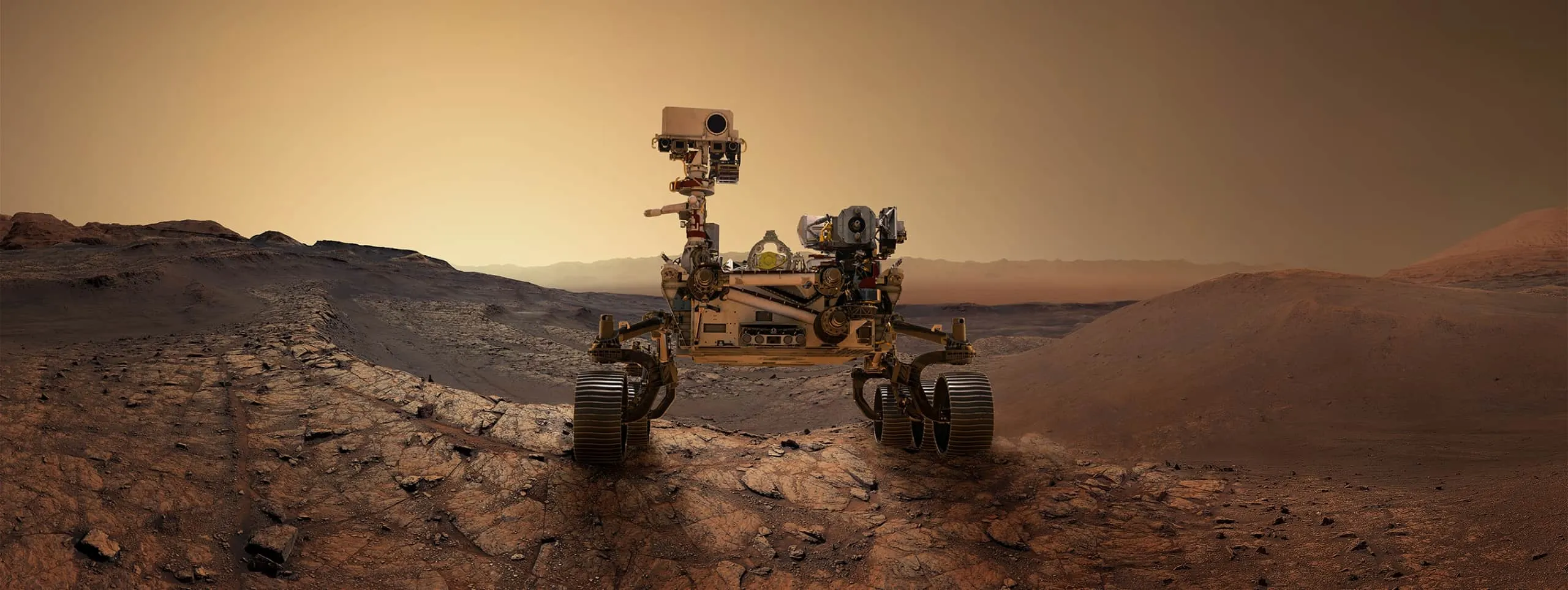
Hindsight
Hindsight is an interactive visualization tool for the engineers and operators of NASA's Mars 2020 Perseverance rover mission. Every decision for the rover is high-stakes and must be rigorously justified. Operators chart the vehicle's daily path by investigating past drive faults and proving future plans are safe, a workflow that relies heavily on institutional memory, the collective and often unwritten knowledge of the operations team. Hindsight adds a similarity search engine on top of that, so an operator can ask for drives that look like a given one instead of writing a database query.
Design Research
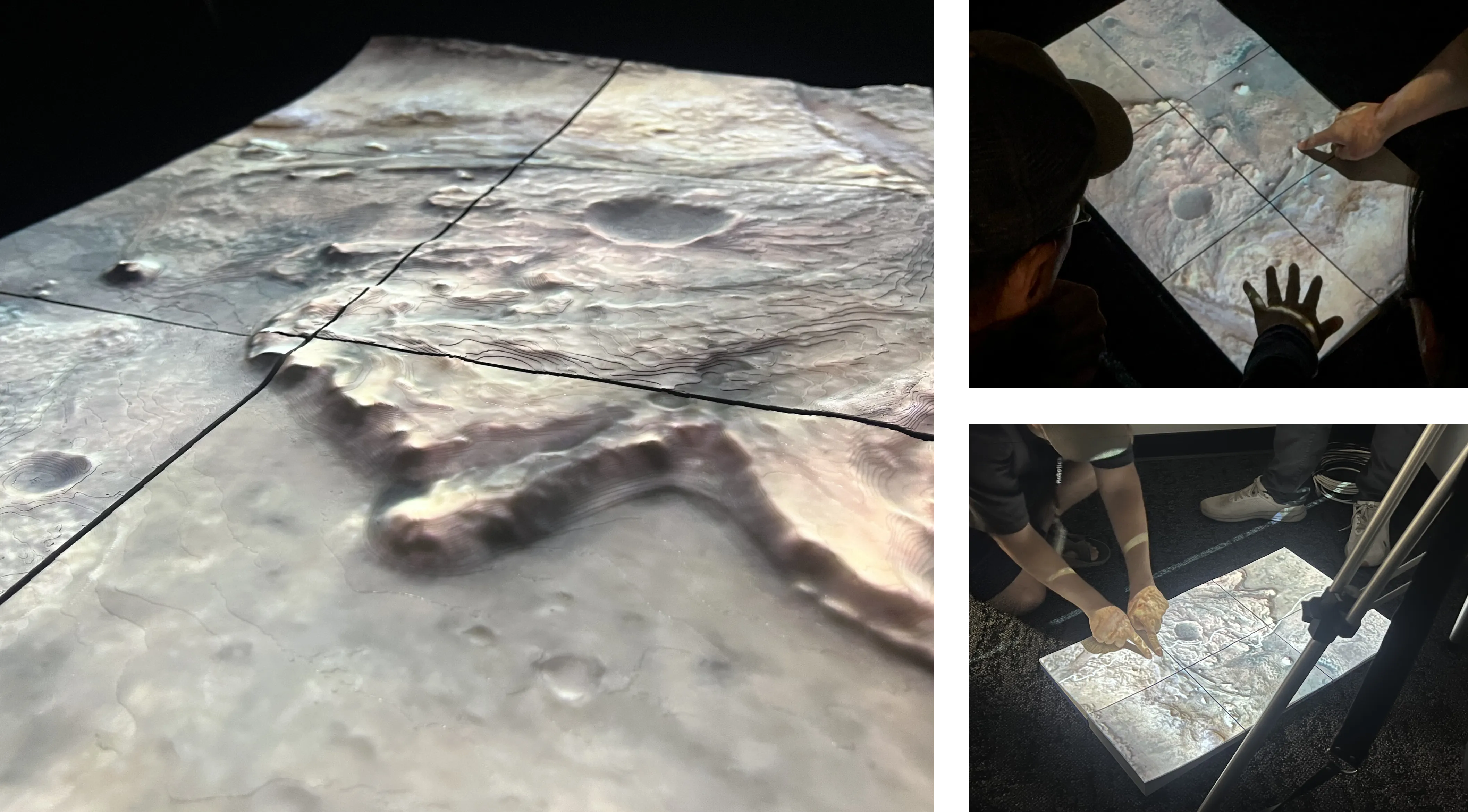
The original brief was a database with standard parametric queries. We spent the first five weeks on design probes instead, trying to work out how operators actually think. One was a projection-mapped model of Jezero Crater, a 3D-printed terrain map with rover paths and telemetry thrown onto its surface. Operators leaned over it and argued with each other about routes.
The projection-mapped model was created with support from ArtCenter Fellow Adam Xu.
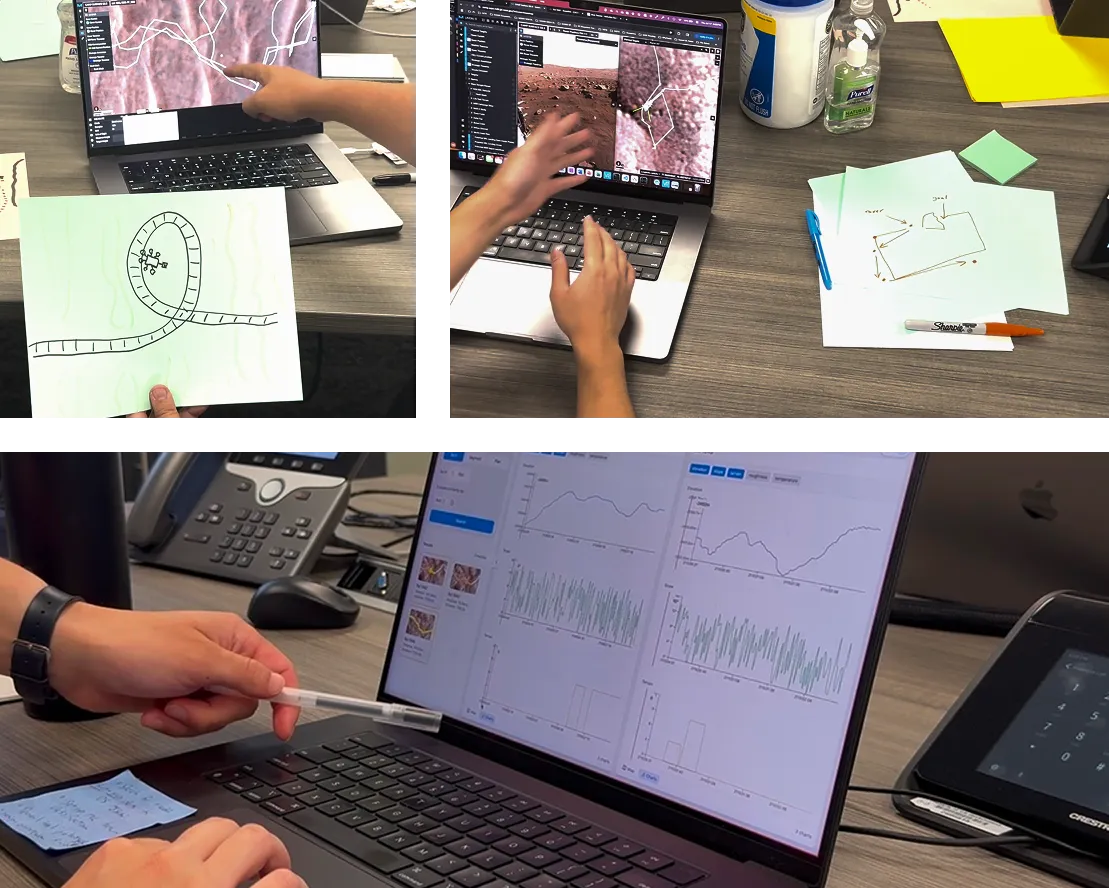
Another probe asked operators to draw their most memorable drive. Nobody drew a chart. They drew the whole run: the terrain, the slope where it got interesting, what the rover did about it. What an operator wants out of the archive is a drive that resembles the one in front of them, and resemblance is not something you can express as a range on a slider. So we built the tool around similarity.
The Tool
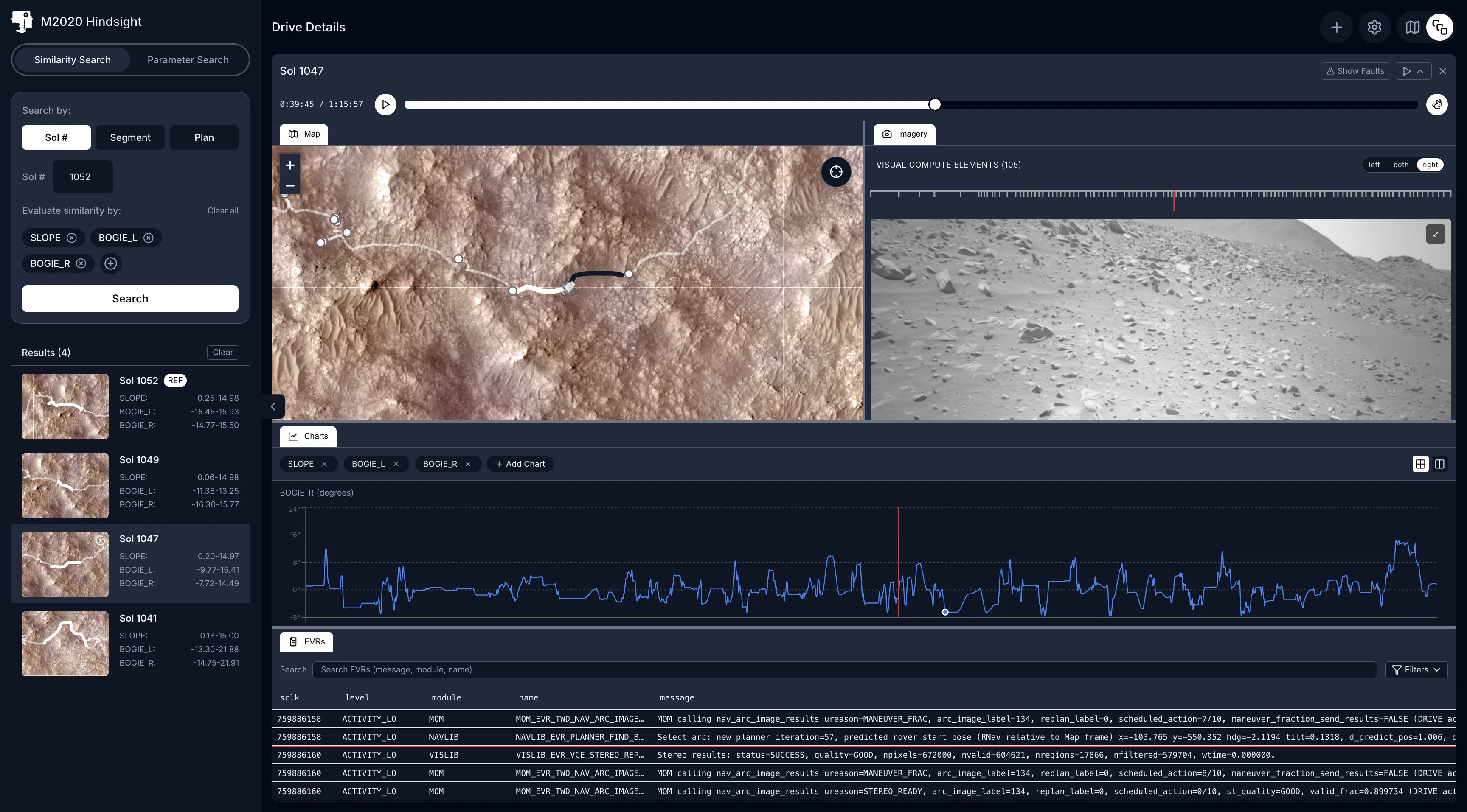
Hindsight's similarity search uses Dynamic Time Warping to compare the shape of time-series data (wheel slip, motor current, terrain type) across drives. It ranks past drives that behave like a reference drive even when they differ in length or location. The results land in a side-by-side layout, so an operator can put orbital paths, telemetry and event records next to each other without leaving the page.
Synchronized Analysis
For a deep-dive on one drive, a synchronized playhead scrubs the timeline and moves the rover's position on the orbital map, the chart values, the software event records and the rover imagery together. Drag it to the moment a fault was logged and every panel is showing that moment.